CASE STUDY
Mapping the Unseen: Advanced Bathymetry and GIS in the Search for MH370
Sector : Natural Resources and Environment I Geography : Asia-Pacific I Country : Australia, China, Malaysia
Case Study
Mapping the Unseen: Advanced Bathymetry and GIS in the Search for MH370
Mapping the Unseen: Advanced Bathymetry and GIS in the Search for MH370
Source: Esri
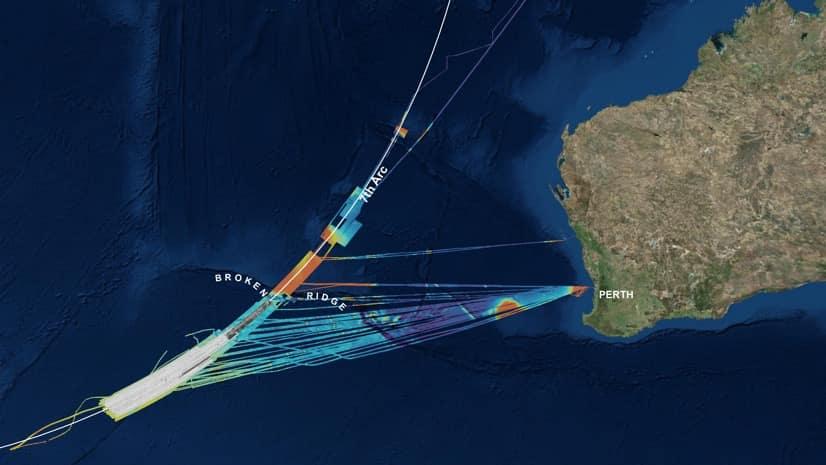
The disappearance of Malaysia Airlines Flight MH370 on March 8, 2014, triggered one of the most extensive and technologically advanced search operations in history. Led by Australia, the mission relied on cutting-edge GIS technology and undersea mapping to explore over 450,000 square miles of the southern Indian Ocean. Initial satellite data analysis revealed a probable crash site along a remote arc, where rugged topography concealed any potential debris field.
The operation began with aerial surface searches but quickly shifted to underwater mapping using multibeam and sidescan sonar to survey the ocean floor. Geoscience Australia played a pivotal role by developing detailed 3D maps of the seafloor, identifying gaps in sonar coverage, and prioritizing areas for further investigation by AUVs. This meticulous mapping unveiled hidden oceanic features, including volcanic ridges and deep trenches, while creating an “underwater highway” to optimize the exploration of anomalies. Although the aircraft remains missing, the mission produced a wealth of bathymetric data, enhancing the scientific understanding of one of the most remote parts of the ocean.



Australian Transport Safety Bureau, Commonwealth of Australia; Government of Malaysia

Geoscience Australia; Fugro